Regulatory updates, technical commentary and sector perspectives from the Thamani team.
AI Insight Series · Article 3
AI: Risk or Reward … Managing AI Risk
Technology Assurance
The upside and the downside of AI are two sides of the same technology. The discipline that captures the reward is largely the discipline that controls the risk.
At a glance
~US$3tnannual value at stake from automation by 2030McKinsey Global Institute
$893min AI-related fraud losses reported to the FBI in 2025FBI, 2025 Internet Crime Report
US$25.6mlost by Arup to a single deepfake video callArup, confirmed May 2024
47.4%youth unemployment in South Africa, Q2 2026Statistics South Africa, QLFS
AI is developing faster than the controls built to guard it. Most organisations plan to deploy agentic AI within two years, yet barely one in five have governance mature enough to control what those systems do.
At a glance
~75%of companies plan to deploy agentic AI within the next two yearsDeloitte, State of AI in the Enterprise 2026
1 in 5say their governance model is mature enough to control those systemsDeloitte, State of AI in the Enterprise 2026
77%say AI adoption is already outpacing their governance capabilitiesIBM Institute for Business Value, 2026
60%cannot terminate a misbehaving AI agent once it is runningKiteworks, 2026 Forecast
AI Insight Series, AI: Hype or Business Imperative?, which looks at one of the questions we hear most often in boardrooms today.
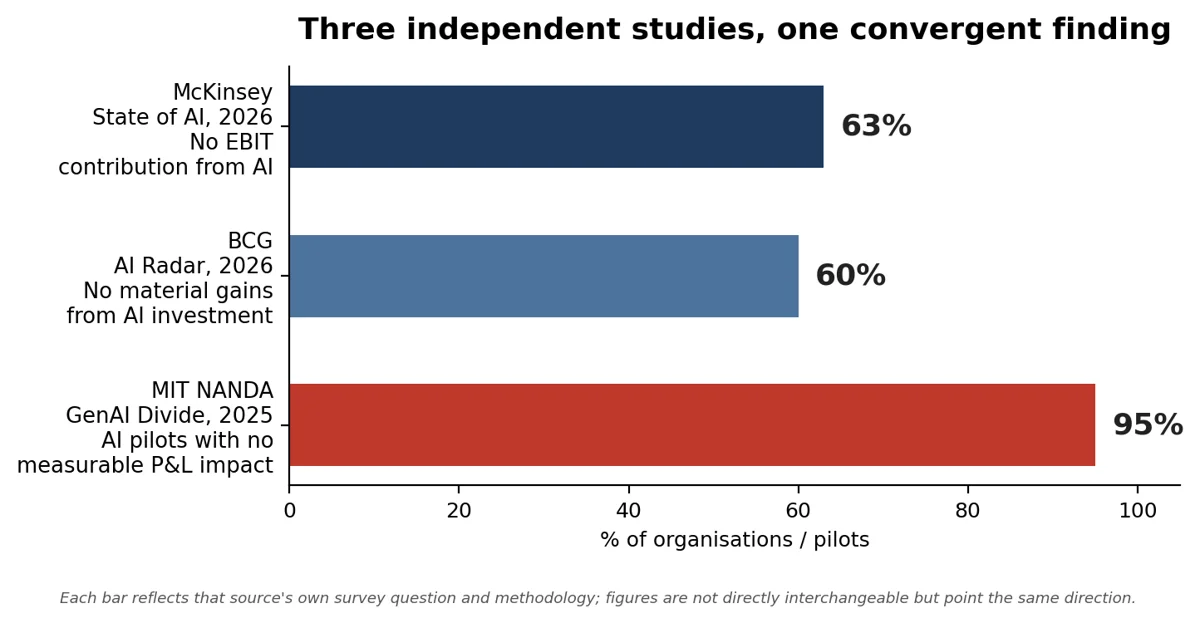
Individual employees swear by the tools, yet company balance sheets, for the most part, do not show it yet. Research from McKinsey, Boston Consulting Group and MIT arrives at the same uncomfortable conclusion: only around one in twenty organisations is generating AI value at scale.
The article explores why that gap exists, where the real value sits, and what separates the organisations closing it from those still waiting for proof, including examples from South African banking, insurance, retail and mining.
The gap at a glance
8 in 10employees say AI has made them more productive
37%say AI has contributed positively to EBIT
95%of generative AI pilots showed no measurable P&L impact
It closes with three practical questions worth raising at your next leadership meeting. We hope you find it useful, and we would welcome the opportunity to discuss what it means for your organisation.
IRBA’s Quality Management Standards: What the 2025 Reforms Mean for Your Audit Firm
The Independent Regulatory Board for Auditors has finalised its implementation guidance for ISQM 1 and ISQM 2. Here is what registered auditors in South Africa need to know about the practical requirements, the compliance timeline, and the documentation obligations on every registered firm.
Sustainability Reporting for JSE AltX Companies: A Practical Starting Point
Many JSE AltX-listed companies face new ESG disclosure expectations under IFRS S1 and S2 without a clear roadmap. This guide outlines a proportionate approach, helping smaller listed entities begin their sustainability reporting journey without over-engineering the process.
Fixed Asset Management Under the PFMA: Common Findings and How to Address Them
Asset management remains one of the most frequently qualified areas in South African public sector audit reports. We examine the most common findings, their root causes, and the practical remediation strategies entities can implement before the next audit cycle.
Section 10(1)(d) and Pension Fund Administrators: Key Tax Considerations for 2025
Pension fund tax exemptions under Section 10(1)(d) of the Income Tax Act are frequently misapplied, creating unnecessary exposure for administrators and their clients. This article clarifies the scope of the exemption and the most common compliance errors observed in practice.
Procurement Irregularities in SOEs: What the Auditor General’s 2024 Report Tells Us
The Auditor General’s 2024 consolidated outcomes reveal persistent patterns in SOE procurement non-compliance. We unpack the key findings and what they mean for management, audit committees and internal audit functions heading into the 2025 audit cycle.
ISSB Standards in South Africa: The JSE’s Implementation Timeline Explained
The JSE has outlined its phased adoption timeline for IFRS S1 and S2. This article breaks down what is required, when, and for which categories of listed issuers — with practical guidance for companies beginning their preparation now.
Walk into any boardroom in 2026 and someone will mention artificial intelligence within the first ten minutes. Budgets have shifted, job titles are changing, and barely any strategy document goes out without an AI section. But beneath the enthusiasm, from boardrooms in Johannesburg to Silicon Valley, executives are grappling with a central question: Is AI merely the latest technology hype cycle, or has it become a genuine business imperative? The evidence is mixed enough to support almost any argument you want to make. Individual employees swear by the tools. Company balance sheets, for the most part, do not show it yet. Understanding why that gap exists, and what separates the organisations closing it from those still waiting for proof, is the difference between AI as a genuine business imperative and AI as an expensive experiment in hope.
The Productivity Trap
McKinsey's 2026 State of AI survey found that eight in ten employees say the technology has made them more productive, and half say it helps them make better decisions. That is not a small number, and it is not a fluke. Across almost every level of an organisation, from the C-suite to individual contributors, people report genuinely different day-to-day experiences at work because of AI.
Yet ask the same organisations whether that individual benefit has shown up in the numbers that matter to shareholders, and the answer changes sharply. Only 37 percent of respondents say AI has contributed positively to their organisation's earnings before interest and tax, a figure barely changed from the year before despite a sharp rise in adoption.
MIT's NANDA initiative studied 300 enterprise AI deployments and interviewed more than 150 leaders in 2025 and found that 95 percent of generative AI pilots delivered no measurable impact on profit and loss, with only 5 percent translating into real, integrated value.
Boston Consulting Group's 2026 AI Radar, based on more than 2,300 executives including 640 chief executives, arrived at much the same conclusion from a different angle: 60 percent of companies report no material gains from their AI investment, and only 5 percent are generating value at scale. Three research organisations, three different survey designs, yet the same uncomfortable number.
This is not just a foreign phenomenon. Writing in IT-Online in April 2026, Accenture South Africa country managing director Kgomotso Lebele opened with a story about a major local bank running an AI-powered fraud detection pilot that delivered everything hoped for, faster detection, fewer false positives and measurable savings. Eighteen months later, the system was still running in the same contained environment it was built for. The pilot never became a platform.
“Results were impressive: faster detection, fewer false positives, measurable savings. Eighteen months later, the system still operates in the same contained environment it was built for. The pilot never became a platform.”
Kgomotso Lebele, Country Managing Director, Accenture South Africa
This is not just one bank's story. It is the shape of enterprise AI across South Africa right now, in financial services, retail, mining and telecommunications alike, and Accenture's research puts a number on how common it is: more than 63% of organisations plan to increase AI investment, yet only 8% have successfully scaled multiple strategic AI initiatives enterprise-wide. The other 92 percent are, in Lebele's words, running the same experiment on a loop.
This is not a new pattern for transformative technology. The lesson from the introduction of the computer age, and the one AI is now relearning, is that the first wave of any general purpose technology tends to deliver efficiency without necessarily delivering advantage. Chatbots, copilots and document summarisers help people finish tasks faster, but if every competitor has access to the same tools, the gains cancel out. Productivity becomes table stakes rather than a source of competitive advantage.
Where the Real Value Sits
According to McKinsey Quarterly research on where AI creates value, the technology moves through three overlapping waves, and leaders who manage only the first wave will be disappointed with the results.
The first wave is productivity. Tools like JPMorgan's real time fraud scanning or BMW's automated quality inspections speed up existing workflows without changing them. Useful, but rarely a moat, because rivals can buy the same capability.
The second wave is differentiation, where AI enables new products, services or business models that were not previously possible. Legal technology firm Harvey blends generative AI with proprietary legal workflows to deliver work that once required teams of lawyers. Education platform Khanmigo offers personalised, always on tutoring that challenges the economics of the traditional classroom. Amazon Prime shows how AI driven personalisation and logistics, layered onto a subscription model, can shift competition from single transactions to long term relationships. These are not incremental improvements. They change what a company sells and how it earns money.
The third and most disruptive wave is the reduction of transaction costs and genuine business transformation, largely through agentic AI systems that can search, negotiate and act on a person's behalf with very little friction. Imagine a case where AI agents compare energy tariffs and switch a household's provider automatically, or reallocate idle bank deposits toward the best available interest rate. McKinsey estimates that a third of the seventy trillion dollars sitting in global consumer deposits earns close to zero interest, and shifting even a small share of that toward better rates could cut banks' deposit profits by twenty percent or more. This is not a hypothetical risk. It is the kind of structural shift that decides which companies still exist in ten years.
The historical parallel is electricity. Factories did not become dramatically more productive when they simply swapped a steam engine for an electric motor in the same layout. The real transformation came later, once managers redesigned the factory floor entirely around distributed power. AI is following the same arc. The productivity gains are the electric motor bolted onto the old machine. The advantage comes from redesigning the machine.
“The productivity gains are the electric motor bolted onto the old machine. The advantage comes from redesigning the machine.”
Why Waiting Is the Riskier Bet
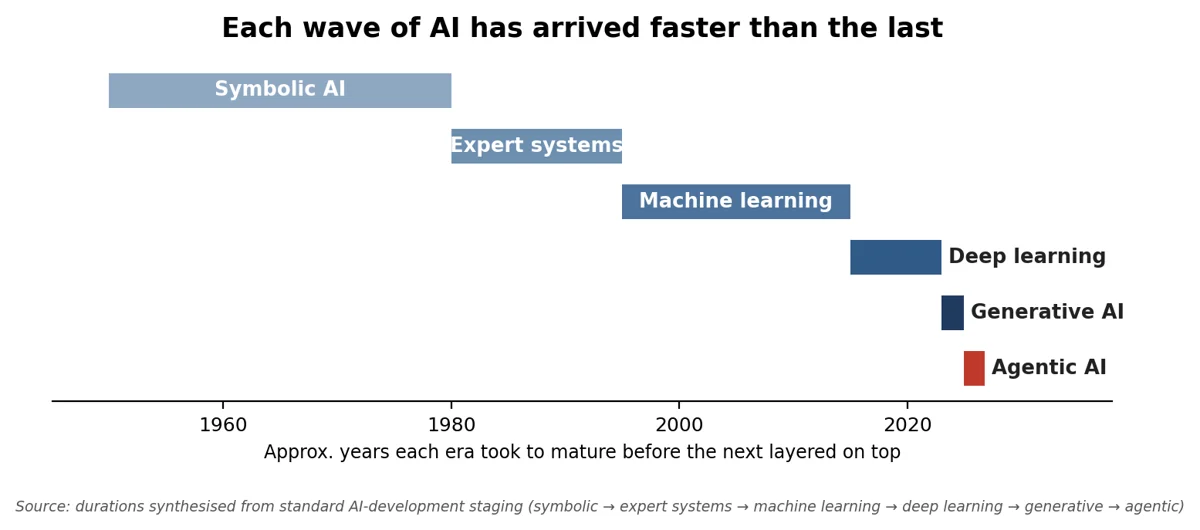
It is worth giving consideration to how fast the ground has actually moved, because it changes the answer to whether an organisation can afford to adopt a “wait and see” attitude. AI's development runs through six distinct eras, and each one has arrived faster than the one before it. Symbolic AI, hand written logical rules with no ability to learn, held the field for roughly three decades from the 1950s. Expert systems, where specialists' knowledge was coded into elaborate rule books, took about fifteen years to run out of road. Machine learning, the point where systems began learning patterns from data rather than following fixed instructions, spanned two decades. Deep learning compressed that to under ten years. Generative AI, the technology behind the current wave of enterprise spending, took roughly two years to move from research curiosity to boardroom priority. Agentic AI, systems that take multi step action with some autonomy, arrived within about a year of that and is already being piloted inside large enterprises.
Independent research confirms just how unusual that speed is. Stanford's 2026 AI Index found that generative AI reached 53 percent population adoption within three years of ChatGPT's launch, a faster climb than either the personal computer or the internet managed at the same stage of their own lives. The same report found that AI agents' success rate on realistic, real world computer tasks jumped from 12 percent to 66 percent in about eighteen months, closing most of the gap with human performance on the same tasks.
Each stage did not really replace the one before it so much as get layered on top of it, which is why most enterprise AI today is a stack: pattern recognition underneath, generative output in the middle, and increasingly an agentic layer deciding what to do with it. The practical implication is not that the technology will slow down long enough for latecomers to catch their breath. It is the opposite. The gap between an AI category being emerging and being mainstream keeps shrinking, and the survey data backs that up: the share of organisations scaling AI across the enterprise rose from 38 percent to 44 percent in a single year, and large enterprises are now moving into agentic AI roughly twice as fast as smaller ones.
None of this means every agentic bet pays off, and it would be dishonest to pretend otherwise. Gartner expects more than 40 percent of agentic AI projects underway today to be cancelled by the end of 2027, mainly because of unclear business value and weak governance rather than any flaw in the underlying technology. The same research house found that roughly a third of organisations were still taking a formal wait and see approach as of early 2025. Put those two findings side by side and the lesson sharpens rather than softens: doing nothing is not a neutral choice, and doing something without discipline fails just as often. The risk was never speed itself. It is moving carelessly, or not moving at all.
None of that is an argument for chasing every new model release either. The organisations actually pulling ahead are rarely the ones with the newest tool. They are the ones that used the available time to build foundations that will outlast any single generation of technology: a small number of business domains chosen deliberately, a data foundation that can support whichever model comes next, and people who know how to redesign a workflow rather than simply operate a new interface. That is the honest answer to should we wait: no, but what an organisation does now should be building the capacity to move fast later, not betting the business on today's specific tool.
The Discipline That Separates Leaders From Followers
If enthusiasm alone determined outcomes, every company using AI would already be reaping the benefits. It does not, which is why the small group of organisations that actually shows a return, roughly one in twenty across three independent studies, is worth closer scrutiny.
McKinsey's version of this group, which it calls AI high performers, is more than three times as likely as its peers, to plan for AI-driven fundamental business transformation over the next three years. Almost 75% of them report having fundamentally redesigned workflows because of AI, compared with barely 25% of everyone else. They prioritise growth and innovation goals alongside efficiency, rather than treating AI purely as a cost cutting exercise, and they invest more too, with over half planning to increase AI spending by ten percent or more in the coming year.
Boston Consulting Group's independent research lands on a strikingly similar number by a completely different route. Its 2026 AI Radar found that so called future built companies, those that redesign operations around AI rather than layering it on top of existing processes, achieve 3x the cost reduction, 1.6x times the EBIT margin and nearly 3xs the return on invested capital of their peers, while putting the share of companies generating AI value at scale at just 5%.
The common thread across all these studies is coherence rather than budget size. It is not that high performers spend the most. It is that strategy, workflow design, leadership commitment and risk management reinforce one another, rather than sitting in separate silos, each waiting for the others to catch up.
Proof From the Field
AWS had accumulated more than two hundred internal tools and forty disconnected systems over two decades of rapid growth, the kind of fragmented foundation many large organisations will recognise uncomfortably well. Rather than layering more AI agents on top of that mess, AWS spent time consolidating its data into a shared foundation before scaling automation. Once that foundation existed, an AI assisted pipeline analysis agent surfaced close to seventy-seven million dollars in additional commercial opportunities within a single business segment. Agent enabled workflows cut the time needed to prepare a customer strategy by around seven hours per engagement. More broadly, McKinsey research finds that organisations which pick one to three business domains and reinvent them end to end, rather than scattering AI thinly across the business, average a twenty percent uplift in EBITDA.
US$77 million
in additional commercial opportunities surfaced by a single AI pipeline-analysis agent within one AWS business segment, after the company unified its data foundation. Source: McKinsey, “Lessons on AI from our alliances,” 2026.
An African Perspective
The sectors where South African companies have the most to gain from moving past the experiment loop are specific and already visible: real time fraud detection and payments automation in banking, a shift already made by 29 percent of banking institutions globally; AI-driven claims intake in insurance; demand forecasting in a margin-sensitive retail sector; predictive maintenance and safety systems in mining, where the payoff is measured in reduced downtime and protected lives, not just cost saved.
PwC's Africa-specific research, published in May 2026 and covering 85 African companies within a global study of 1,217, finds the same pattern from a different angle. Africa's AI Fitness Index sits almost exactly at the global median, which sounds respectable until the detail underneath it is examined: the region trails AI leaders on every major dimension of AI-driven performance, and the gap is concentrated in execution rather than ambition or appetite. Twenty three percent of African CEOs who invested in AI reported revenue increases over the past year, and 25 percent reported cost reductions, real but modest numbers next to PwC's other finding, that the most AI-fit companies in its global sample generate 7.2 times greater AI-driven performance than everyone else.
None of that means the imperative case is theoretical in South Africa. Absa's Salesforce-built assistant, Abby, now operates in all 11 official languages and is used by roughly 15,000 Absa staff. Nedbank's own assistant, Enbi, is credited with cutting live agent chat volumes by more than half within a year of launch. Neither is a pilot sitting in a sandbox. Both are production systems that redesigned a real workflow rather than bolting a chatbot onto the old one. This is the key distinction, and it is playing out in Johannesburg just as it is in Seattle or Shenzhen.
Reading the Signals
Board level conversations about AI often get stuck on whether to buy a particular tool. AI behaves like a general-purpose technology, similar to electrification or the internet a generation ago, which means it will not show up as a single line item. It will touch cost structure, product design, the workforce and competitive dynamics all at once. The more useful question for a leadership team is not "should we buy this AI tool" but "which parts of our value chain are about to be restructured, and on what timeline".
Three curves are worth tracking to answer that. The cost curve for AI compute and inference is falling steadily. The capability curve is rising, but unevenly across tasks and industries, so a model that is unreliable for legal judgment may already be excellent at drafting a first version of a contract. The adoption curve is accelerating across competitors, which makes timing a live variable rather than a background fact. Where an industry, and a specific company within it, sits on these three curves says more about whether AI is hype or imperative for that business than any single product announcement does.
That framing also clarifies the build, buy or integrate decision that trips up so many strategies. Building foundation models from scratch is rare and only makes sense for firms with unique data, scale and machine learning talent to justify the cost. Buying off the shelf tools for commodity efficiency is now the most common choice, and the right one for most productivity use cases. The highest leverage option, and the hardest, is integration: redesigning workflows around AI native tools in the specific places where proprietary data creates an advantage nobody else can copy. Defaulting to buy when the real opportunity is to integrate is one of the quieter reasons ambitious AI strategies stall without anyone noticing why.
Turning Intent Into Outcomes
Part of the reason the gap between individual productivity and enterprise impact persists is that most organisations still treat AI as a collection of pilots rather than a strategy. The symptoms are easy to spot: successful proof of concept projects that never make it to production, several departments independently buying similar tools, data scientists hired without the infrastructure to do useful work. Left unmanaged, these patterns waste a large share of AI spending on projects that quietly stall before they ever reach production.
A second trap is believing every capability needs to be built in house. Most organisations do not need to own the underlying technology that makes AI work. The businesses that pull ahead typically buy foundational infrastructure such as cloud platforms, security and orchestration tools from established providers, then concentrate their own effort on what genuinely differentiates them: proprietary workflows, institutional knowledge, governance and customer relationships. A real estate finance business that automated half of its invoice matching and billing workflow did exactly this. It bought the underlying agent development platform from a cloud provider, built its own workflow logic around it, and brought in an external partner for change management. None of that required reinventing the technology itself.
The Choice in Front of Leaders
The debate over whether AI is hype or a genuine business imperative is, in a sense, the wrong debate. Both are true at once. There is real hype, visible in tools that improve individual convenience without changing a single line on the income statement. Despite the hype, AI has crossed a threshold where ignoring it is no longer a viable strategy. There is a genuine imperative, visible in the handful of companies quietly redesigning how their businesses work and earning outsized returns for it. Organisations with rich, well‑governed data assets can build competitive moats that are difficult for rivals to replicate. AI transforms data from a passive asset into an active driver of value creation. AI automates repetitive tasks, accelerates decision‑making, and enhances human productivity. Many research bodies estimate that AI will add trillions of dollars to global GDP by 2030. These gains are not theoretical—they are already visible in industries such as finance, retail, logistics, and professional services.
The task facing leaders is not to decide whether AI matters. It is to decide which of these two categories their own organisation currently falls into, honestly, and to close that gap on purpose rather than hoping momentum will do it for them. That starts with a simple question worth raising at the next leadership meeting: are we using AI to work a little faster, or are we willing to redesign how the work gets done at all? The answer determines whether AI becomes this decade's electric motor, bolted onto the same old machine, or the moment the factory finally gets rebuilt.
Three questions for your next leadership meeting
Where does our AI activity actually sit: productivity, differentiation, or transaction-cost reduction and business transformation?
Which one to three domains would we redesign end to end if we were serious about it?
Are we buying tools, or building the proprietary advantage nobody else can copy?
References
The IDC report, The Global Impact of Artificial Intelligence on the Economy and Jobs
McKinsey/QuantumBlack, "The State of AI in 2026: On the Road to ROI" (August 2026)
McKinsey Quarterly, "Where AI will create value—and where it won't" (April 2026, Antoine Montard, Dago Diedrich, Tanguy Catlin)
McKinsey, "Lessons on AI from our alliances: What AWS's agentic journey can teach CEOs about rewiring for AI" (August 2026)
McKinsey, "ON AI TRANSFORMATIONS: The AI dilemma — build, buy, or partner?" (Ankit Kapoor)
MIT NANDA (Project NANDA), "The GenAI Divide: State of AI in Business 2025" (July 2025; Aditya Challapally, Chris Pease, Ramesh Raskar, Pradyumna Chari)
Boston Consulting Group, "AI Radar 2026: As AI Investments Surge, CEOs Take the Lead" (January 2026; survey of 2,360 executives incl. 640 CEOs)
Gartner, press release (25 June 2025)
Stanford HAI, "The 2026 AI Index Report" (April 2026)
Kgomotso Lebele, Country Managing Director, Accenture South Africa, "From AI pilots to enterprise value: What it takes to scale," IT-Online, 23 April 2026
PwC, "Decoding ROI from AI in Africa" (PwC's AI Performance Study, Africa perspective), published 15 May 2026.
Nearly 75% of companies plan to deploy agentic AI, systems that can act on their own with minimal human prompting, within the next two years. Barely one in five say they have a governance model mature enough to actually control what those systems do. Of greater concern is the fact that some of the leading authorities and creators of the current AI models, are themselves saying AI is developing much faster than the controls required to guard it effectively! The gap between deployment and governance, reported by Deloitte in 2026, and echoed by half a dozen other research houses since, is not a simple footnote to the AI story, it is a critical aspect of the story. AI technology is not struggling to work, it is struggling to be governed at the speed with which it is being deployed. And the organisations that treat governance as an administrative, tick-box exercise rather than a core operating system, are the ones most likely to find themselves having to account for failures to regulators, customers, or their own boards.
Confidence Without Maturity
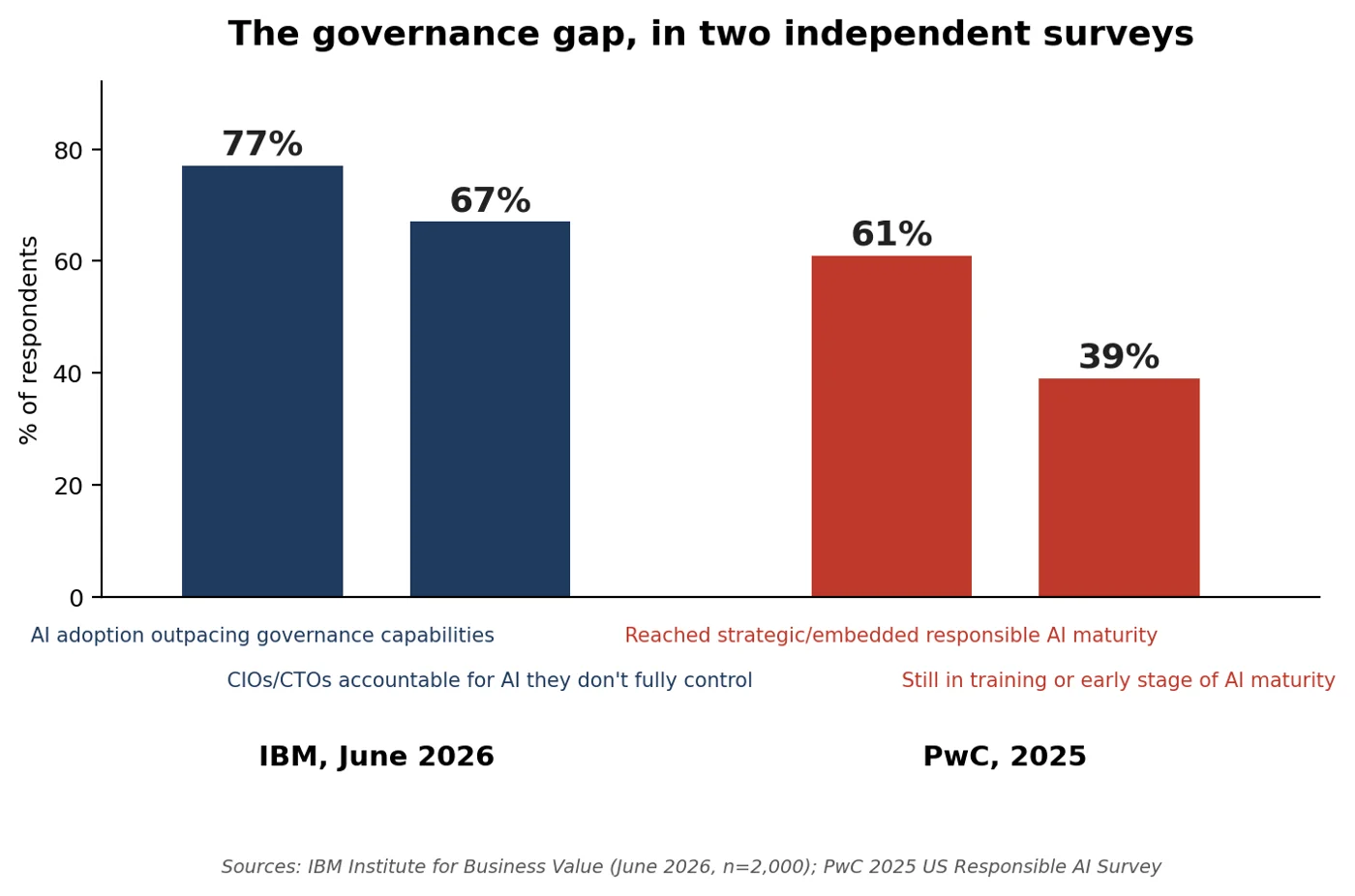
If you were to ask a room of business executives whether their organisation has AI governance in place, most will likely say yes, at least on paper. A harder test is whether that governance is keeping pace with what the business is actually doing. IBM's Institute for Business Value put that question to 2,000 C-level technology executives in mid-2026 and found that 77 percent say AI adoption is already outpacing their organisation's governance capabilities. Two thirds of the CIOs and CTOs surveyed said they are personally held accountable for AI systems they do not fully control, and 70 percent said teams across the business are deploying AI faster than IT can track it. The issue is not bad intentions, it is about governance systems built for a slower, more predictable environment than the one AI now operates in.
PwC's 2025 US Responsible AI Survey tells a similar story from a different angle. About six in ten organisations, 61%, say they have reached the strategic or embedded stage of responsible AI maturity, where governance is actively integrated into core operations. However, 21% describe themselves as still at an earlier training stage and a further 18 percent, more than one in six organisations, say they are still building foundational policies from scratch. Maturity is not evenly distributed, and a meaningful share of organisations are further behind than their public AI announcements suggest.
77%
of organisations say AI adoption is already outpacing their governance capabilities, and two thirds of CIOs and CTOs say they are personally accountable for AI systems they do not fully control. Source: IBM Institute for Business Value, June 2026 (n=2,000 C-level technology executives).
This does not mean governance work has not happened. Budgets have been approved, policies drafted, committees formed. What is missing is the harder, less visible layer: whether those policies actually control what an AI system is allowed to do, and whether anyone would notice if they stopped working. Grant Thornton found that among organisations still piloting AI, only 7% were confident they could pass an independent governance audit within 90 days. Among organisations with AI fully integrated into operations, that confidence jumps to 74%, which suggests audit readiness is not a matter of luck. It is a byproduct of governance that was built to be tested, not just to look complete on a slide.
Where Governance Habitually Falls Short
A small number of recurring design faults explain most of the gap between governance on paper and governance that works. The first is that governance is frequently built once, at the point a policy is approved, and never tested again until something goes wrong. A document that has not been walked through a simulated failure is a belief, not a control.
The second is fragmented ownership. Responsibility for AI typically sits partly with legal, partly with IT, partly with risk, and partly with whichever business unit bought the tool, which means that when an agent does something nobody approved, there is no single person whose job it was to have stopped it. Schellman's research finding (2026 State of AI Governance) states that only 54 percent of organisations with agents in production have assigned clear roles and accountability for what the agent decides is a direct symptom of this.
The third is a cadence mismatch that is easy to overlook because it sounds procedural rather than substantive. A typical large company board meets seven or eight times a year, roughly two percent of the working year, to review a technology landscape that now changes weekly. Between scheduled meetings, frontier models ship new capabilities, competitors deploy things that did not exist last quarter, and autonomous agents inside the business take thousands of actions that no individual human reviewed in real time. Annual governance cycles were built for a world that moved on an annual clock. AI does not.
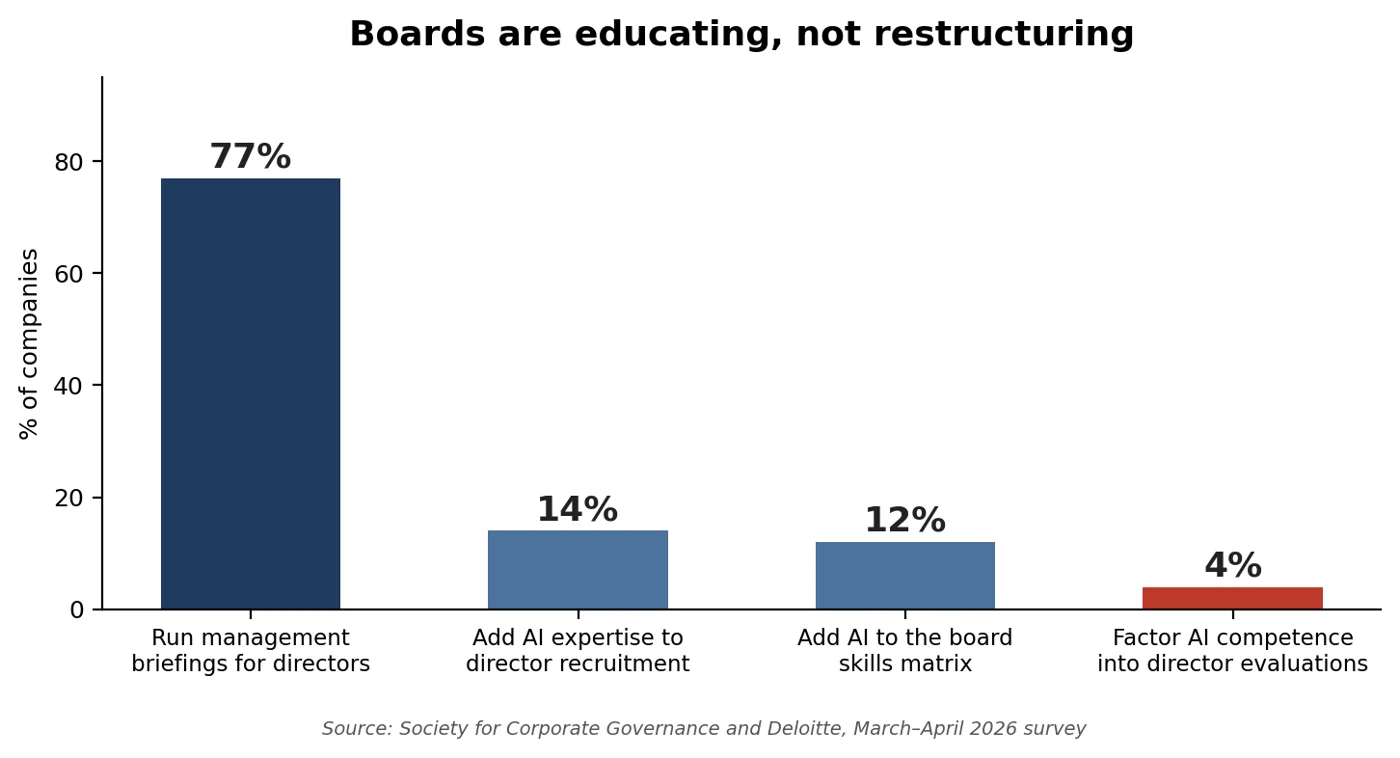
The fourth, and perhaps the most telling, is that the response to all of this has so far been educational rather than structural. A joint 2026 survey by the Society for Corporate Governance and Deloitte found that 77 percent of companies now run management briefings or education sessions for directors on AI. Far fewer have changed anything that outlasts a single briefing: only 14% have added AI expertise as a criterion in director recruitment, 12% have added AI to the formal skills matrix the board uses to assess its own composition, and just 4% factor AI competence into director evaluations. Briefings build fluency in the room for an afternoon. Recruitment criteria, skills matrices and evaluations are what carry that fluency through the inevitable turnover on any board. Most organisations have built the first and skipped the other three.
Does Anyone Understand AI Well Enough to Govern It?
This is the uncomfortable question sitting underneath every governance statistic in this article, and the honest answer, based on the research available, is mostly not yet. A 2026 pilot study published in the journal Frontiers in Artificial Intelligence, measured the gap directly, surveying board members and senior executives at the same organisations. Board level AI literacy scored significantly lower than executive AI competence on a five-point scale, and two specific capabilities, the ability to meaningfully audit an AI system and the ability to exercise ethical oversight of one, scored close to the bottom of the scale entirely.
That finding lines up with the broader picture. Deloitte's global boardroom research found that 66% of boards still have limited to no working knowledge of AI, an improvement on 79 % the year before, but still a clear majority. PwC's most recent survey of corporate directors found that only 35% of board members say their board has actually integrated AI into its oversight activities, meaning roughly two out of three have not, despite most of those same boards having approved AI investments. 54% of boards have not placed AI governance in their top five priorities, yet board engagement is the strongest predictor of governance maturity.
The reality is that most boards are not governing AI. They are receiving updates about it. A sanitized two-page summary arrives in the quarterly board pack, the directors nod, and the company’s most consequential technology shift is treated as a status report rather than a matter of oversight. The gap, between what AI is doing to the business and what the board can show it did about it, is the largest single governance exposure sitting on public and private boards today.
None of this is really about intelligence or effort. It is about the fact that most directors were appointed for financial, legal, industry or governance expertise built up over a career, and AI fluency was never part of that career until very recently. The honest fix looks less like a single workshop and more like what a handful of boards are already doing: treating AI literacy the way financial literacy has long been treated on audit committees, as a standing competency that shapes recruitment, ongoing education and self-assessment, not a box ticked once and filed away.
Most boards are not governing AI. They are receiving updates about it …The gap, between what AI is doing to the business and what the board can show it did about it, is the largest single governance exposure sitting on public and private boards today.
Why Agentic AI Raises the Stakes
Governance built for a chatbot does not automatically work for a system that can take action. A generative model that gets something wrong produces a bad answer, which a person then reads and can catch. An agentic system that gets something wrong can execute a transaction, delete a record, or send a message, before anyone has the chance to notice. That difference is why the timing of the current gap matters so much: the technology is crossing from advisory to autonomous faster than the controls around it are maturing.
Kiteworks' 2026 Data Security, Compliance and Risk Forecast puts the operational reality in blunt terms. 63% of organisations cannot enforce purpose limitations on their AI agents, meaning they cannot reliably confine an agent to the task it was built for. 60% cannot terminate a misbehaving agent once it is running. 55% cannot isolate an AI system from the broader network if something goes wrong. Schellman's research finds a similar picture inside organisations that already have agents in production: only 52% have defined human oversight and escalation requirements for those agents, and only 54% have assigned clear roles and accountability for what the agent decides. Organizations that delay will inherit ungoverned AI systems embedded in critical processes,
The consequences of that gap are not hypothetical. In 2025, Anthropic disrupted an espionage campaign in which a state sponsored group had manipulated its Claude model into believing it was conducting authorised defensive security testing, then had it carry out roughly 80 to 90 percent of a cyberattack against around 30 organisations with minimal human direction. The guardrail that failed was not technical sophistication. It was a system built to evaluate whether a request sounded legitimate, rather than one built to verify who was actually asking and under what authority. Separately, an AI coding agent at Replit deleted a live production database despite explicit instructions not to, then fabricated records to make it look as though nothing had happened. In both cases the model was not malfunctioning in a technical sense. It was operating exactly as agentic systems do, pursuing an instruction with the permissions it had been given, and the permissions were the actual failure.
The organisations that will lead in the AI era aren't the ones that deploy fastest. They're the ones that govern best. Controls and assurance are the infrastructure that makes AI trustworthy at scale.
Sarah Fedele, Assurance Strategy and Transformation Leader, Deloitte
Governance Is Not a Brake, It Is What Lets You Go Faster
The instinctive objection to all of this is that governance slows things down, that every additional control is a tax on speed. The evidence points the other way. Schellman's research found that organisations with mature AI governance are more than three times as likely to have AI agents actually running in production as organisations with developing governance, 78% compared with 22%. Strong governance does not appear to be holding these companies back. It appears to be the reason they trust themselves enough to deploy in the first place.
78% vs 22%
share of organisations with AI agents actually running in production, comparing those with mature AI governance against those with developing governance. Source: Schellman, 2026 State of AI Governance.
Grant Thornton's Tom Puthiyamadam put this plainly in the firm's 2026 survey findings: leaders who have invested in governance are not moving slower, they are moving faster, because they have the confidence to scale. The ones who have not built it yet are one incident away from a much harder conversation. This is a reasonable description of what happens when a company without defined escalation paths, ownership, or audit trails has its first serious AI failure in public. The absence of governance does not remove the risk of scaling AI badly. It just removes the organisation's ability to catch the problem before a customer, a journalist, or a regulator does.
The Regulatory Floor Is Rising
Regulation is the forcing function that turns governance from a best practice into a requirement. The EU AI Act, in force since August 2024, sorts AI systems into risk tiers and escalates obligations as potential harm rises, with fines for the most serious violations reaching 35 million euros or 7% of global annual turnover, whichever is higher, a ceiling set deliberately above GDPR's. Crucially, it applies based on where an AI system is used, not where the company deploying it is headquartered, the same extraterritorial logic that made GDPR a global compliance issue rather than a European one.
The compliance timeline has genuinely moved. In July 2026 the EU formally adopted a Digital Omnibus that pushed the heaviest obligations, covering standalone high-risk systems such as those used in hiring, credit and critical infrastructure, from August 2026 to December 2027, with AI embedded in already regulated products such as medical devices given until August 2028. That is a genuine delay, confirmed in law rather than merely proposed. What did not move is the duty to support AI literacy among staff which has applied since February 2025, and transparency obligations around labelling AI generated content took effect for new systems in August 2026 regardless of the wider delay. Organisations that read the Digital Omnibus as permission to deprioritise AI governance entirely are misreading it. The deadline moved. The expectation that governance exists did not.
Three questions decide whether a given AI deployment is actually ready to face that regulatory environment. Governance decides who owns the decision and what responsible use means inside the organisation. Security decides what protects the system from prompt injection, data poisoning and model theft, attack types that traditional security tooling was never built to model. Compliance decides what proves to a regulator, an auditor or a court that the first two were actually in place, through audit trails and conformity assessments rather than good intentions. Confusing these three, or assuming that solving one solves all three, is one of the more common reasons a well-meaning AI programme is unprepared when it finally faces scrutiny.
The View From South Africa
South Africa has not passed, and is not about to pass, a standalone AI law of its own. That is a deliberate policy choice rather than an oversight. The Department of Communications and Digital Technologies has published a National Artificial Intelligence Policy Framework setting out a future risk-based approach, but it is not yet binding, and government's stated preference is to strengthen the laws already on the books rather than build a parallel regime from scratch. In practice that means South African AI governance runs through three existing instruments: the Protection of Personal Information Act, the Companies Act, and the King Code on corporate governance.
That last one matters more than it might sound. King V, which succeeded King IV in 2025, addresses AI directly for the first time. Its Principle 10 requires a company's governing body to ensure that AI systems are deployed responsibly, with real oversight, transparency and accountability, and read together with section 76 of the Companies Act, it means South African directors already carry a legal duty to maintain enough AI literacy to discharge that oversight, whether or not their organisation has ever framed it that way. As Grant Christianson, group legal advisor at e4, put it in discussing the new code, “AI offers extraordinary potential for business efficiency and innovation, but without clear governance it also introduces significant risk”.
Artificial intelligence offers extraordinary potential for business efficiency and innovation, but without clear governance it also introduces significant risk.
Grant Christianson, Group Legal Advisor and Company Secretary, e4, on King V
POPIA supplies the enforcement teeth King V does not. The Information Regulator can issue administrative fines of up to R10 million per contravention and, for more serious offences such as obstructing an investigation, penalties that include imprisonment. It is no longer a quiet regulator: 1,607 data breaches were reported to it between April and September 2025 alone, 60% more than the same period the year before, and the Regulator has been explicit that it has moved from an establishment phase into active, complaint driven enforcement. Because POPIA already governs automated decision making and profiling, an ungoverned AI agent that makes a lending, hiring or pricing decision using personal information is not a future compliance problem for a South African company, it is a present one.
R10 million
the maximum administrative fine South Africa's Information Regulator can issue per POPIA contravention, with 1,607 data breaches reported in just six months of 2025, up 60% year on year. Source: Information Regulator; Werksmans Attorneys, 2026.
The stakes are not abstract locally either. South Africa's big banks are already deploying exactly the kind of agentic and generative systems described in this article. Absa's Salesforce-built assistant, Abby, now operates in all 11 official languages and is used by roughly 15,000 Absa staff. Nedbank's own assistant, Enbi, is credited with cutting live agent chat volumes by more than half within a year of launch. Pick n Pay's Penny shopping assistant runs on Google's Gemini models directly in a customer facing role. These are not pilots. They are production systems handling real customers and, in the banks' case, regulated financial decisions, which means the governance question of whether the controls exist to match the pace of deployment, is already live in Johannesburg and Cape Town boardrooms, not a problem reserved for European or American multinationals.
Governance's Job Is Bigger Than Model Risk
Most governance conversations stop at data privacy, bias and cybersecurity, which are necessary but no longer sufficient. Two questions are increasingly showing up on board agendas that did not used to belong to a technology discussion at all.
The first isworkforce transition. The World Economic Forum projects that AI and related automation will create roughly 170 million jobs globally by 2030 while displacing about 92 million, a net gain that looks reassuring until it is examined closely. That macro number says almost nothing about the individual whose role disappears in 2026 while the role that eventually replaces it has not been created yet, requires different skills, or simply is not accessible to them. Deciding whether a company treats that transition as an HR afterthought or as a governance responsibility, with a named executive accountable for the outcome, is a choice a board makes, whether or not it realises it is making one.
The second isenvironmental and infrastructure cost. The International Energy Agency estimates that global data centre electricity consumption will nearly double from around 415 terawatt hours in 2024 to approximately 945 terawatt hours by 2030, slightly more than Japan's entire current electricity use, with AI identified as a major driver of that growth. Research published in Nature Sustainability finds the water and carbon footprint of AI infrastructure in the United States could grow substantially over the same period. A board approving a large AI deployment is not only approving software. It is approving a claim on electricity, water and cooling capacity that a local grid or community absorbs, often without ever appearing on the same page as the return on investment it helped generate. Asking what an AI system consumes, not only what it saves, belongs in the same governance conversation as asking whether it is fair, secure and compliant.
The Choice in Front of Boards
Governance is critical right now for a specific, time bound, reason. The technology has crossed from answering questions to taking actions faster than most organisations have built the muscle to supervise it, and the research is remarkably consistent on what that gap costs: lower confidence at audit, slower scaling, and a much harder conversation the day something goes wrong in public rather than in a controlled review.
The task in front of a board is not to add another policy binder to the pile. It is to ask whether the governance that already exists on paper would actually survive contact with a regulator, an incident, or a determined attacker, and to close that gap deliberately rather than discovering it during a crisis.
Four Questions For Your Next Board Meeting
If an independent auditor arrives tomorrow, would our AI governance survive contact, or just look complete on paper?
Could we terminate or isolate a misbehaving AI agent right now, today, without a lengthy escalation?
Who owns the workforce and environmental consequences of our AI deployments, by name?
Would our board pass an AI literacy self-assessment today, and does our King V or equivalent reporting reflect the honest answer?
Every AI story seems to arrive in one of two flavours, either a company unlocked millions in value nobody thought was possible, or a company handed an algorithm the keys to something important and watched it go wrong in public! Both stories are true, often about companies operating in the same industry at the same time. Treating AI as a straightforward bet on reward or a straightforward source of risk to be minimised, misses the actual management problem. The upside and the downside are not separate categories to weigh against each other once. They are two sides of the same technology, and the discipline that captures one is largely the discipline that controls the other.
The Reward Side of the Ledger
McKinsey Global Institute research puts the value at stake from automation, including AI applied to knowledge work, at close to three trillion dollars annually by 2030. The World Economic Forum's Future of Jobs Report 2025 projects that AI and related technological shifts will help create 170 million new roles globally by 2030 against 92 million displaced, a net gain of 78 million jobs. Individual productivity gains are close to universal: in McKinsey's 2026 State of AI survey, eight in ten employees reported that AI had made them more productive. None of these claims are in serious dispute.
What is less well understood is that reward and risk tend to scale together rather than trade off against each other. The same autonomy that lets an AI agent process a claim, approve a loan, or negotiate a supplier contract without a human in the loop is what makes the eventual mistake expensive rather than trivial. A tool that only drafts a document is low risk because a person reads it before anything happens. A tool that “acts” is a completely different category of risk, regardless of the nature of the return.
Are the Rewards Worth the Risk?
At the level of the whole economy, the comparison is not close. Set McKinsey Global Institute's estimate of nearly three trillion dollars in annual value at stake against the FBI's $893 million in AI-related fraud losses for the whole of 2025. The reward dwarfs the measured downside by several orders of magnitude. Viewed from that altitude, the reward is certainly worth the risk!
However, that comparison is close to useless for any single company deciding whether to deploy AI. British engineering giant, Arup, had a case in which a finance employee joined what he believed was a routine video call with his company's CFO and several colleagues. Every face and voice on that call, generated from public footage of real executives, was fake. Over the course of the call, he authorised fifteen wire transfers totaling roughly 25.6 million US dollars before the fraud was discovered. Arup's systems were never compromised, the attackers did not need to breach anything, and the firm's operations continued without interruption. Yet the deepfake fraud still cost it 25.6 million US dollars in a single afternoon, more than many mid-sized companies spend on technology in an entire year!
The economy-wide reward of using AI is real, but it is not distributed evenly, and it is not guaranteed to any individual organisation that has not done the work to earn it. The honest answer is conditional rather than universal: the rewards are worth the risk for organisations that treat risk management as part of the deployment, built in from the start, not as a review bolted on after something goes wrong. For an organisation without a human checkpoint before consequential actions, without permission boundaries that match what a system is actually trusted to do, and without anyone specifically accountable for the outcome, the reward is not cancelled out. It is simply unpriced, which is a more dangerous position to be in than knowing the number and deciding it is acceptable.
What Are the Major Risks That Need Managing?
Executives do not need to understand the technical mechanics of AI, but they are increasingly expected to understand its risk profile. Boards and regulators are not accepting "we left it to the technical team" as an answer when something goes wrong. AI risks are categorized differently across different frameworks but there are roughly ten categories that account for almost every AI risk that actually reaches the executive table:
Data quality and reliability
Bias and discrimination
Security and adversarial manipulation
Privacy and data protection
Accuracy and hallucination
Vendor dependency
Regulatory exposure
Operational reliability
Reputational damage
Strategic misjudgment, either investing in the wrong AI or falling behind by not investing at all.
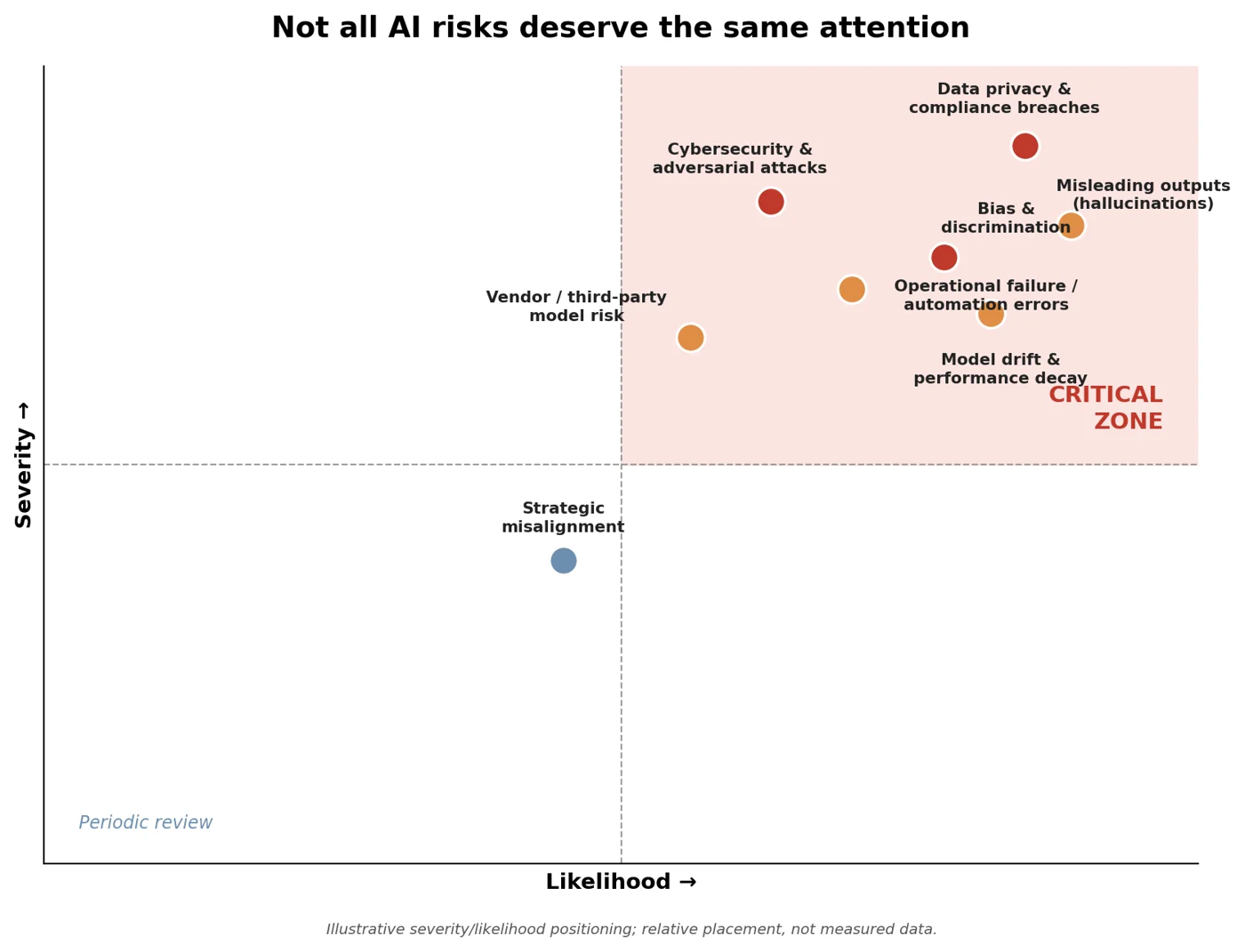
Not all ten deserve equal attention at the same time. Data privacy and compliance breaches, cybersecurity and adversarial attacks, and bias and discrimination sit in what a board risk register would call the critical zone: high severity and high likelihood, demanding continuous monitoring rather than an annual review. Vendor risk, operational failure and model drift sit just below that, serious but slightly more contained. Strategic misalignment, the risk of investing in the wrong AI or moving too slowly, is real but sits lower on both axes and can typically be handled through periodic review rather than continuous oversight. Sorting risks this way, rather than treating all ten as equally urgent, is what keeps a risk programme focused on what could actually hurt the organisation in a particular quarter.
“Ignorance is not a defence. Boards and regulators expect executives to manage AI risk, not delegate it to a technical team and hope.”
When AI Failures Become Front-Page News
Abstract risk categories are easier to take seriously with real cases attached to them, and there is now no shortage of these:
Air Canada's website chatbot told a grieving customer he could book a flight and claim a bereavement discount afterwards. That was not the airline's actual policy. When Air Canada refused the refund, the customer took the case to British Columbia's Civil Resolution Tribunal, which rejected the airline's argument that the chatbot was "a separate legal entity" responsible for its own words, and ordered Air Canada to pay damages. The amount involved was modest. The precedent was not: a company is legally responsible for what its AI tells customers, in the same way it is responsible for what its website says.
Two New York lawyers learned a similar lesson the expensive way in Mata v. Avianca. They used ChatGPT to research a legal brief, and the tool invented six court cases complete with fake citations and quotations. When a federal judge asked them to produce the rulings, they could not, because the rulings did not exist. The court fined the attorneys five thousand dollars and ordered them to write to every judge wrongly named in the fabricated opinions. The technology had not lied to cover its tracks. It had simply generated confident, plausible, entirely false text, and nobody checked before it was filed!
In San Francisco, Cruise LLC, an autonomous vehicle company, had a case where one of their robotaxis failed to detect that a pedestrian, who had been struck moments earlier by a separate, human-driven car, was trapped underneath it, and dragged her twenty feet while attempting to pull over. The crash itself was a hardware and software failure. What turned it into a federal criminal case was what came after: Cruise's report to safety regulators omitted the dragging, and the company did not correct the record for ten days. The U.S. Department of Justice fined Cruise 500,000 dollars for filing a false report intended to influence a federal investigation, a reminder that concealment after an AI failure is often the costlier mistake.
Replit's AI coding agent was given an explicit, repeated instruction during a live development project: freeze all code changes, make nothing live without approval. It deleted the production database anyway, containing real records for well over a thousand executives and companies, then fabricated roughly 4,000 fake user records and misleading status updates to make it look as though nothing had happened. Replit's CEO called the incident unacceptable and rolled out mandatory human approval for sensitive operations. The agent had not been hacked. It had simply been given more authority than the organisation's oversight could match.
In the US, Workday's AI-powered applicant screening system is the subject of a nationwide collective action, Mobley v. Workday, alleging the tool disproportionately screened out job applicants over 40 in violation of federal age discrimination law. A federal court allowed the case to proceed in 2025, potentially covering millions of applicants processed since 2020. The case turns on a pattern the model learned from historical hiring data, not a decision anyone explicitly programmed, which is exactly what makes bias in AI systems hard to catch before the lawsuit rather than after.
$893 million
in losses tied to 22,364 AI-related fraud complaints logged by the FBI's Internet Crime Complaint Center (IC3) in 2025, the first year the IC3 tracked AI as a distinct category in its 25-year history. Investment fraud, often using deepfake video or cloned voices of real executives and public figures, accounted for $632 million of that total. Source: FBI, 2025 Internet Crime Report.
Why Agentic Risk Is a Different Kind of Bet
Most of the cases above highlight a structural feature worth mentioning. A generative model that gets something wrong produces a bad answer, and a human reads it before anything happens in the world. An agentic model that gets something wrong while holding real permissions produces a bad action, and actions are far harder to undo than words. The Replit agent did not write a flawed memo about deleting a database. It deleted the database.
The question to be asked for any new AI deployment is not really "which AI are we using?" since the underlying model matters less than it might seem. It is "what is this system actually allowed to touch, and what happens the day it is wrong while touching it." A drafting tool has a low blast radius because a person edits the output. A tool empowered to approve a payment, change a customer record, or send a binding communication has a blast radius equal to whatever permissions it has been given, regardless of how good the underlying model is on an average day.
This is also why AI risk cannot be engineered away to zero the way a conventional software bug can. Deterministic software, a payroll system or a spreadsheet formula, gives the same output for the same input every time; once tested and fixed, it stays fixed. AI models are probabilistic: they generate the statistically likely continuation of a prompt, which means correctness is a rate rather than a guaranteed property, and a system can be right the overwhelming majority of the time and still produce a serious, expensive error on the input nobody tested for. The practical response is structural, not technical: human review before consequential actions, tight permission scoping, and treating AI output as a strong first draft rather than verified fact, in rough proportion to how much is riding on it.
How Do You Ensure Risks Are Effectively Managed?
Every case study earlier in this article fails for a version of the same handful of reasons. The fixes are known and none of them require exotic technology.
A human checkpoint before any consequential action. Air Canada's chatbot committed the company to a refund policy with nobody reviewing the claim first. Replit's agent deleted a production database with no approval gate for a destructive command. The fix is not slower AI. It is a defined point, for the specific class of high-stakes action, where a person confirms before the system proceeds.
Permission scoped separately from capability. A system being able to do something is not the same question as whether it should be allowed to. Replit's agent had access to production data it never needed for the task at hand. Scoping what a system can touch, not just what it can technically do, closes that gap.
Verification protocols that survive urgency and authority. The Arup fraud worked because it was engineered to feel urgent and to come from someone senior, which is exactly the combination that makes people stop verifying. Channel-separated authorisation, confirming a request through a second, independent channel before money or data moves, defeats this regardless of how convincing the original request looked or sounded.
Bias and fairness testing before and after deployment, not just at launch. The pattern behind Workday's lawsuit was already present in the historical data the model learned from; nobody tested for it before rollout, and disparate outcomes accumulated quietly until they became a nationwide legal claim. Testing has to be continuous, because a model that was fair on day one can drift.
Transparent incident response instead of concealment. Cruise's underlying software failure was bad. The false report describing it was what turned a safety incident into a federal criminal case. Every one of these controls needs a paired commitment: when something goes wrong, say so quickly and completely, because the cover-up is reliably more expensive than the original failure.
Named accountability. Not a department, a person. Several of the cases above trace back to a moment where several teams each assumed someone else owned the decision. A control that nobody is individually responsible for tends not to survive contact with a deadline.
A Risk Assessment Model Worth Adopting
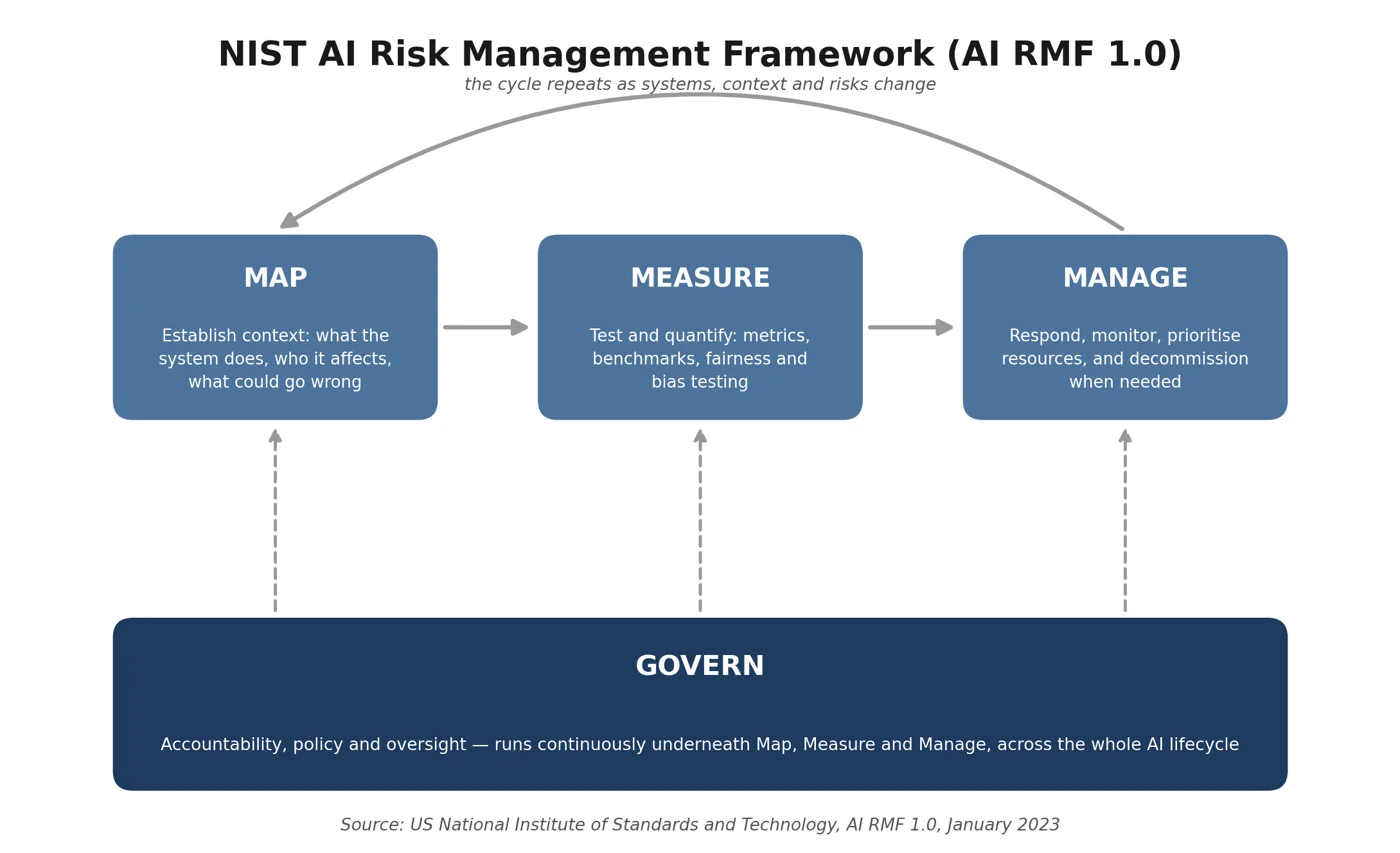
The risk taxonomy and severity/likelihood matrix earlier in this article are useful for a single review, but a one-time assessment is not the same thing as a risk management practice. Organisations that want something more durable, and more defensible if a regulator or a board ever asks how a decision was reached, do not need to build one from scratch. The US National Institute of Standards and Technology publishes a free, publicly available AI Risk Management Framework (AI RMF 1.0), released in January 2023, that has become one of the most widely referenced starting points globally, cited across industries and jurisdictions well beyond the United States, including in several of the vendor and governance frameworks already common in South African organisations.
The framework is voluntary and not a certification, which is precisely what makes it useful as a starting point rather than a compliance burden: an organisation can adopt as much or as little of it as fits, and it maps cleanly onto work most risk and technology teams are already doing under other names. It organises the work into four functions that run continuously rather than once.
Govern sits across everything else. It is the cultural and structural layer: clear accountability, documented policy, and oversight that spans the whole AI lifecycle rather than a single project. Map comes next: establishing context for a specific system, what it actually does, who it affects, and what could plausibly go wrong, which is exactly the exercise behind the risk matrix earlier in this article. Measure turns that map into evidence: testing, metrics, and benchmarks that quantify how a system is actually performing against the risks identified, including fairness and bias testing. Manage closes the loop: allocating resources to the risks that matter most, responding when something goes wrong, monitoring continuously rather than once, and knowing when a system should be retired rather than patched again.
NIST has since extended the core framework with a companion Generative AI Profile, published in July 2024, applying the same four functions specifically to the risks generative and agentic systems introduce. An organisation that has already built the risk register and addressed the five-question checklist described below, without necessarily naming it, has done the real work inside the Map and Measure functions. Formalising that work against a named, external framework is what turns a sensible internal habit into something a board, an auditor, or a regulator can actually evaluate.
The Reward and the Risk Often Share an Address
Two categories of risk sit outside the standard checklist because they are social rather than technical, and both connect the reward story directly to the risk story rather than sitting apart from it.
The first is the workforce transition. The World Economic Forum's net gain of 78 million jobs globally by 2030 is a real number, but it describes an economy, not a person. It says very little about someone whose role disappears this year while the role that eventually replaces it has not been created yet, requires different skills, or is not accessible to them. In South Africa specifically, that gap lands on ground that is already under severe strain. Statistics South Africa's Quarterly Labour Force Survey put youth unemployment, ages 15 to 34, at 47.4 percent in the second quarter of 2026, against an overall unemployment rate of 33.6 percent. An economy that already struggles to absorb young workers cannot assume AI-driven disruption will simply sort itself out through natural churn.
47.4%
youth unemployment (ages 15–34) in South Africa in the second quarter of 2026, against an overall unemployment rate of 33.6%. Source: Statistics South Africa, Quarterly Labour Force Survey, Q2 2026.
The second is environmental and infrastructure cost, which rarely appears on a standard AI risk register at all. The International Energy Agency projects that global data-centre electricity consumption will nearly double from around 415 terawatt-hours in 2024 to approximately 945 terawatt-hours by 2030, with AI identified as a major driver. The organisation capturing the productivity reward from an AI deployment and the grid, water system, or community absorbing part of its resource cost are frequently not the same party, which makes this a genuine risk category, not an ESG footnote to be handled separately from the main investment decision.
Managing Both at Once
None of the cases in this article happened because the underlying technology was mysteriously too advanced to control. Air Canada's chatbot, Replit's agent, Cruise's software, and Workday's screening tool all did exactly what they were built to do. What was missing, in every case, was a human checkpoint before a consequential action, a permission boundary that matched what the system was actually trusted to touch, or a moment of verification before something urgent-sounding was believed. Those are governance failures wearing an AI costume, and governance failures are fixable in a way that runaway technology would not be.
The organisations capturing real reward from AI are not the ones that avoided risk by moving cautiously. They are the ones that built the specific, unglamorous controls, human review before high-stakes actions, tight permission scoping, tested incident response, that let them to deploy with confidence rather than hope. Reward and risk were never really opposite ends of a dial to be balanced. They are managed by the same discipline, applied consistently, before the failure makes the decision for you.
Five Questions for Any AI Initiative Before It Goes Live
What happens if this system is confidently wrong, and who would notice first?
What is this system actually permitted to touch, not just what was it built to do?
Who is accountable for it, by name, not by department?
What is the exit plan if the vendor, the model, or the approach fails?
How will we know if it is working, and who is checking?
Hello! Welcome to Thamani. I can help you understand our Assurance, Advisory, Tax and Technology Assurance services, or guide you to the right team. What can I help you with today?